BSL can be signed naturally with either hand as the dominant hand. If you’re left-handed, the short version is: use your left hand as your dominant hand, sign as you naturally would, and when copying a right-handed demonstration, use the corresponding mirrored movement with your left hand as the dominant hand. Left-handed and right-handed signers understand each other naturally – Deaf signers are used to seeing both.
Sign with your natural dominant hand from day one.
Choose your dominant hand and stick to it
BSL uses the idea of a ‘dominant’ hand (the one that does most of the work) and a ‘non-dominant’ hand (which supports it). For most left-handed signers, the left hand is dominant. The important thing is consistency: switching your dominant hand during a conversation can make your signing harder to follow.
Left-handed signing is still BSL, not a different language
Left-handed signers normally use their left hand as their dominant hand. For most vocabulary demonstrated by a right-handed signer, you use the corresponding form with your left hand taking the dominant role, keeping the same handshape, movement, location and non-manual features. A few things – directional verbs, placement in signing space and role shift – involve more than simply mirroring a video. There is no separate ‘left-handed BSL’.
Two-handed signs still use both hands
In two-handed signs where one hand carries the main movement or handshape, that role is normally taken by the signer’s dominant hand. For a left-handed signer, the left hand takes that role.
Reading other signers
Reading right-handed signers as a left-handed learner.
Because most of the people you’ll watch (teachers, dictionary videos, friends in the Deaf community) are right-handed, your early reading practice is mostly ‘mirror reading’.
It can feel unfamiliar at first and generally becomes easier with practice. The same is true in reverse: a right-handed signer reading you usually adjusts quickly too.
Many learners find fingerspelling the trickiest part, because letters happen quickly and rely on precise handshape.
Stand or sit so you can see the signer’s whole signing space, not just their hands.
If you’re unsure, it’s polite to ask the signer to repeat a letter or word.
Free download
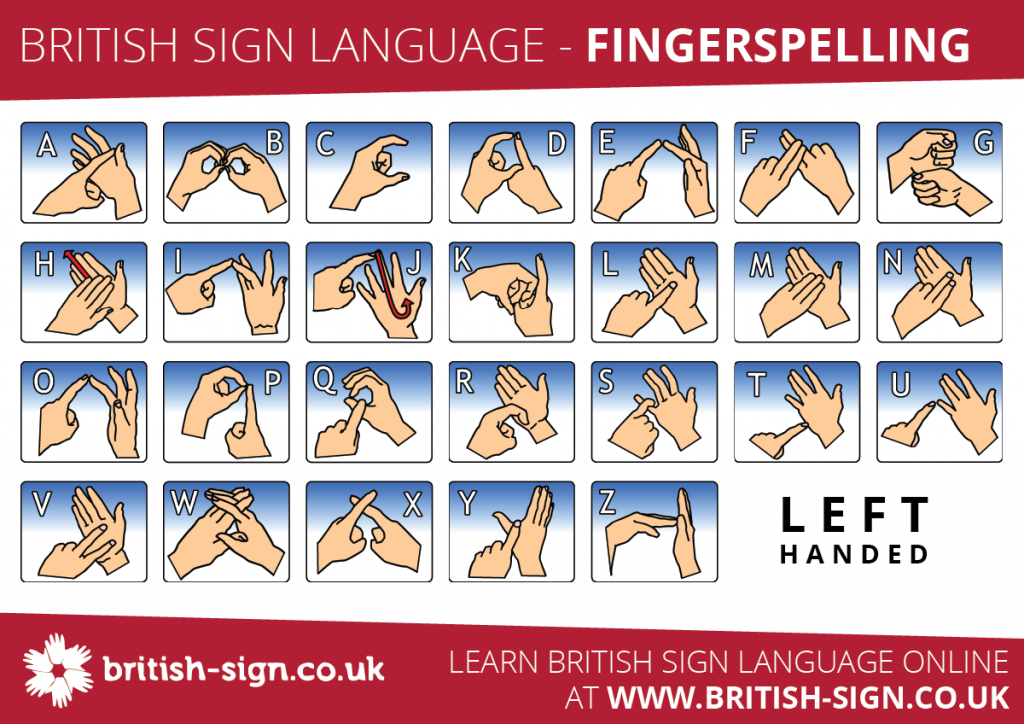
Left-handed BSL fingerspelling alphabet.
A clean reference chart showing each letter produced with the left hand as the dominant hand. Print it and keep it nearby while you practise.
Download the PDFTwo-handed manual alphabet, left-handed version.
Frequently asked
Left-handed signing, common questions.
Will I struggle to learn BSL if I’m left-handed?
No. The vast majority of BSL teaching material is filmed with right-handed signers, but BSL can be signed naturally and clearly with either the left or right hand as the dominant hand. The main adjustment is often mentally mirroring a right-handed demonstration. Choose the hand that feels most natural as your dominant hand and remain consistent where you can.
Should I learn signs as if I were right-handed?
No. Sign with your natural dominant hand from the very start. Forcing yourself to sign right-handed adds an extra layer of translation that will slow you down and make your signing less clear over time.
Will Deaf people find me harder to understand?
Left-handed signers are a normal part of the Deaf community. Clear handshapes, movement and facial expression matter far more than whether your dominant hand is left or right.
What about ambidextrous people?
Pick whichever hand feels marginally more natural and use it consistently. ‘Switching hands’ during a conversation isn’t standard practice and can be harder for the other person to read.
Does the fingerspelling alphabet change for left-handed signers?
The alphabet uses corresponding mirrored handshapes, with the left hand as the dominant hand. You can download the left-handed fingerspelling chart on this page to use as a reference.
Ready to start signing?
Our online BSL course works equally well left-handed.
Ten sections, end-of-section assessments, a certificate of completion for the CPD-certified course and two years’ access. Pay What You Can from £5.